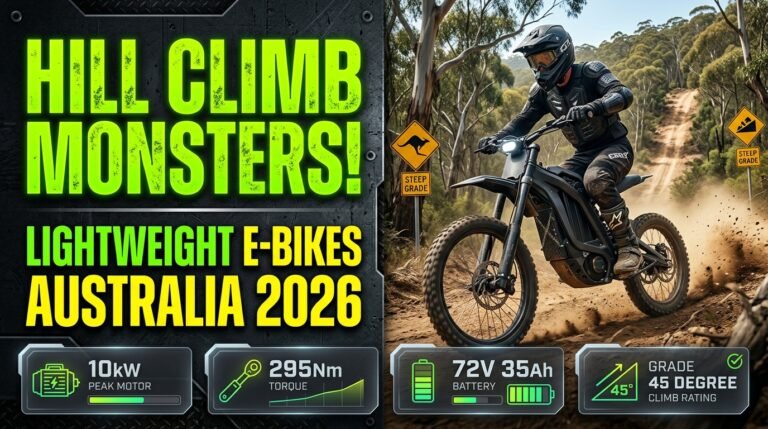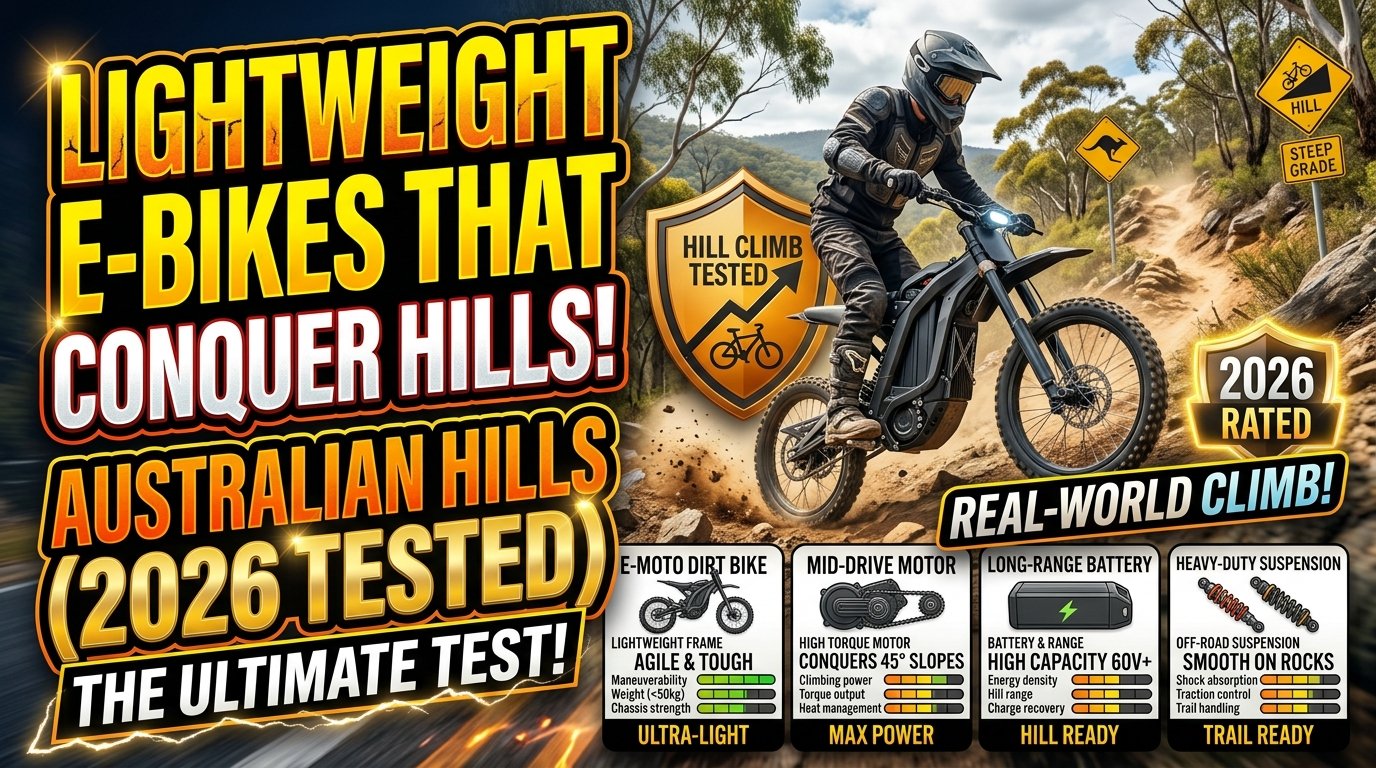

Lightweight Electric Bikes That Actually Conquer Australian Hills (2026 Tested)
Australian hills are where an electric bike proves what it is really made of. A bike can feel fast and comfortable on flat roads, yet struggle badly when the gradient increases. lightweight electric bikes Australia.
That is why choosing lightweight electric bikes Australia riders can rely on requires more than looking at the advertised motor wattage. Weight, torque, gearing, battery capacity, tyres, braking and motor placement all affect how confidently an e-bike climbs.
For 2026, the market has more lightweight options than ever, ranging from efficient commuter e-bikes to lightweight electric mountain bikes designed for steep trails and technical terrain.
The key is choosing the right combination of low weight and useful climbing performance. 🚵♂️
What Makes Lightweight Electric Bikes Good on Hills?
The first mistake many buyers make is assuming that the most powerful motor automatically makes the best hill-climbing bike.
It does not.
A strong hill-climbing e-bike needs to balance several factors:
- Low overall weight
- Strong motor torque
- Useful gearing
- Efficient battery
- Good traction
- Responsive pedal assistance
- Reliable hydraulic or mechanical disc brakes
- Appropriate tyres
- A frame designed for the intended terrain
Weight is particularly important because gravity is working against you on every climb.
A lighter bike requires less effort to move uphill. It is also easier to manoeuvre, easier to lift onto a bike rack and easier to control when descending.
However, ultra-light does not automatically mean better. A bike that saves several kilograms but uses a weak motor, poor tyres or inadequate brakes may perform worse on demanding Australian terrain.
⚡ Torque Matters More Than a Big Wattage Number
When comparing lightweight electric bikes for hills, look beyond the headline wattage.
Torque, measured in Newton-metres (Nm), is one of the most useful specifications for climbing.
Torque determines how strongly the motor can help when the bike is under load.
For example, a lightweight e-bike with a well-designed motor and strong torque delivery can feel considerably better on a steep climb than a heavier bike with a larger-looking wattage figure.
This is especially noticeable when:
- Starting from a stop on an incline
- Climbing long suburban hills
- Carrying luggage
- Riding into a strong headwind
- Tackling gravel or loose surfaces
- Riding technical trails
For serious climbing, look for a motor system that delivers useful torque throughout the climb rather than simply focusing on peak power.
🚴 Mid-Drive vs Hub Motor for Australian Hills
Motor location makes a major difference.
Mid-drive motors
A mid-drive motor sits around the crank area and works through the bicycle’s gears.
That gives the rider a major advantage on steep climbs.
You can select a lower gear and allow the motor to operate efficiently while maintaining a comfortable pedalling cadence.
This setup is particularly attractive for riders living in hilly areas or using an eMTB on steep trails.
Hub motors
Hub motors are positioned inside the front or rear wheel.
They can provide excellent performance for commuting and rolling terrain, while often offering a simpler and more affordable design.
However, on long, steep climbs, a suitable mid-drive system can have an advantage because the motor works through the bike’s gearing.
👉 The best choice depends on your terrain, riding style and intended use — not simply the motor type printed on the specification sheet.
🪶 How Lightweight Should an Electric Bike Be?
There is no single Australian legal definition of “lightweight” for an e-bike.
For shopping purposes, however, it is useful to think about weight in practical categories.
Around 15–20 kg
These bikes are genuinely easy to carry and manoeuvre.
They are particularly attractive for:
- Apartment living
- Stairs
- Public transport
- Short commutes
- Riders who want a traditional bicycle feel
The trade-off can be smaller batteries, less suspension or less motor capacity.
Around 20–24 kg
This is an excellent middle ground.
A bike in this range can still feel relatively agile while offering a larger battery, stronger components and better hill performance.
For many Australian commuters, this is the sweet spot.
24 kg and above
Heavier e-bikes can still be excellent hill climbers.
In fact, many serious electric mountain bikes are heavier because they use larger batteries, stronger suspension, wider tyres and more powerful drivetrain components.
Therefore, do not reject a bike simply because it weighs more.
The real question is whether the additional weight provides useful performance.
🔋 Battery Capacity Matters More on Hills
Hills consume more energy than flat roads.
A rider who regularly climbs steep streets will generally use more battery than someone travelling the same distance on flat terrain.
Battery capacity is normally measured in watt-hours (Wh).
A larger battery can provide greater energy reserves, but it also adds weight.
That creates an important balancing act:
More battery = potentially more range, but also more weight.
For a lightweight electric bike, the goal is not necessarily the biggest battery available.
Instead, choose enough capacity for your actual riding distance and terrain.
Remember that real-world range is affected by:
- Rider weight
- Gradient
- Wind
- Tyre pressure
- Riding mode
- Temperature
- Surface conditions
- Stop-start traffic
- Battery age
So treat manufacturer range figures as a guide rather than a guarantee.
🛞 Tyres Can Make or Break Hill Performance
Motor power means little if your tyres cannot maintain traction.
For urban hills, efficient commuter tyres can provide a good balance between rolling resistance and grip.
For gravel, fire trails and mountain-bike terrain, wider tyres with a more aggressive tread can provide considerably more confidence.
On loose Australian surfaces, traction becomes particularly important.
A lightweight electric mountain bike with suitable tyres can therefore outperform a heavier bike with inappropriate road-oriented tyres when conditions become rough.
🛑 Don’t Ignore the Brakes
Climbing is only half the equation.
If you are riding up a steep hill, eventually you need to come back down.
That makes braking performance critical.
Look for:
- Hydraulic disc brakes where appropriate
- Large enough rotors for the bike and rider
- Quality brake pads
- Strong brake levers
- Proper brake adjustment
- Tyres with sufficient grip
A lightweight electric bike designed for serious hills should give you confidence on descents as well as climbs.
🇦🇺 Australian Hills Are Different
Australian riders encounter a wide variety of terrain.
You might be dealing with:
- Steep suburban streets
- Long regional climbs
- Coastal hills
- Gravel roads
- Fire trails
- Mountain-bike tracks
- Loose and rocky surfaces
- Hot summer conditions
Consequently, the “best” lightweight electric bike depends heavily on where you ride.
A lightweight commuter designed for sealed roads is not automatically suitable for technical mountain-bike trails.
Likewise, a full-suspension eMTB may be unnecessarily heavy and expensive for someone whose biggest challenge is a 10-minute climb on the way home from work.
⚠️ Lightweight Does Not Mean Road Legal
This is particularly important in Australia.
A bike being lightweight, fast or advertised as an “e-bike” does not automatically make it legal for use on public roads and paths.
Australian e-bike requirements can vary between jurisdictions, while compliant pedal-assisted bicycles generally operate within specific power and assistance limits.
High-powered electric motorcycles, electric dirt bikes and performance e-motos are a different category and should not automatically be treated as ordinary road-legal bicycles.
Before buying, check the requirements that apply to your state or territory and the exact model configuration.
🏔️ Lightweight Electric Bikes vs Electric Dirt Bikes
This distinction matters for Australian buyers.
A lightweight electric mountain bike is generally designed around bicycle-style riding, pedal assistance, cycling geometry and trail use.
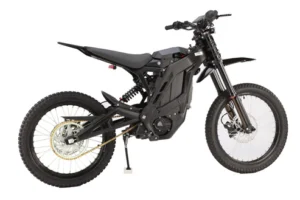
An electric dirt bike or e-moto such as a high-performance Sur-Ron or Talaria is built for a completely different purpose.
These machines can offer substantially more performance, but they should not be assumed to have the same legal status as a compliant pedal-assisted bicycle.
For riders looking for serious off-road performance, an electric dirt bike can make sense.
For commuting, cycling paths and everyday transport, a compliant e-bike may be the more appropriate choice.
🏆 What We Would Look For in 2026
If hills are your main concern, prioritise these features:
1. Low-to-moderate weight
Choose the lightest bike that still provides the performance you actually need.
2. Strong torque delivery
Torque is particularly important for steep starts and sustained climbs.
3. Appropriate gearing
A useful gear range makes climbing more manageable and can help a mid-drive motor work efficiently.
4. Quality battery system
Choose a reputable battery and compatible charging system rather than chasing the biggest capacity.
5. Good tyres
Grip matters enormously on steep or loose surfaces.
6. Reliable brakes
A good climbing bike also needs to handle the descent.
7. Correct suspension
For smooth roads, suspension may be unnecessary. For rough trails, it can transform comfort and control.
8. Legal configuration
Always confirm the exact configuration and rules applicable to where you intend to ride.
🚲 The Best Lightweight Electric Bike Is the Right One for Your Hills
There is no universal winner.
A 17 kg e-bike might be perfect for a rider carrying the bike upstairs every day. A 23 kg mid-drive eMTB may be the better choice for someone climbing steep trails every weekend.
The smartest approach is to start with your terrain.
Ask yourself:
How steep are my hills?
How far do I need to ride?
Am I riding mainly on roads or trails?
Do I need to carry the bike?
How important is suspension?
Do I need a lightweight commuter or a genuine electric mountain bike?
Once those questions are answered, choosing the right bike becomes much easier.
Final Verdict 🏁
The best lightweight electric bikes Australia riders can buy in 2026 are not necessarily the bikes with the smallest frame or biggest advertised motor.
The winning combination is manageable weight, strong torque, sensible gearing, adequate battery capacity, good tyres and dependable brakes.
If you live in a hilly Australian suburb, do not judge an e-bike after five minutes on flat pavement.
Test it where it matters.
Find a proper incline. Start from low speed. Ride the climb. Check how naturally the motor responds. Then pay attention to braking and handling on the way back down.
That is where a genuinely capable electric bike separates itself from the marketing.
At ELECTRICK, the goal is to help Australian riders choose electric bikes and electric mobility products based on how they actually intend to ride — whether that means everyday commuting, mountain trails or serious off-road electric performance.
Frequently Asked Questions
What are the best lightweight electric bikes for hills?
The best lightweight electric bike for hills should combine low weight with strong torque, appropriate gearing, good tyres and sufficient battery capacity. Mid-drive systems can be particularly effective on steep climbs because the motor works through the bicycle’s gears.
Is a lightweight e-bike better for hills?
Not always. Lower weight helps reduce the effort required to climb, but motor torque, gearing, battery output and traction are also important. A slightly heavier eMTB can outperform an ultra-light bike on difficult terrain.
How much torque should an electric bike have for hills?
There is no universal torque figure that guarantees hill performance. However, higher torque can be useful for steep climbs, particularly when combined with appropriate gearing and a well-designed motor system.
Are high-powered electric dirt bikes legal on Australian roads?
Not automatically. High-powered electric dirt bikes and e-motos can fall under different vehicle and road-use requirements from compliant pedal-assisted bicycles. Always check the rules applying to the exact model and your state or territory.
Do hills reduce e-bike battery range?
Yes. Steep climbs generally require more energy than flat riding. Rider weight, wind, tyre pressure, riding mode, temperature and terrain can also significantly affect real-world range.