
Lightweight Electric Bikes That Actually Conquer Australian Hills (2026 Tested)
Finding lightweight electric bikes Australia riders can actually use on steep hills is harder than it sounds.
A bike can be lightweight, compact and easy to carry, yet struggle badly when the road points uphill. On the other hand, some powerful e-bikes climb extremely well but weigh more than 25 kg and become difficult to lift, transport or maneuver.
For Australian riders, the sweet spot is a combination of low weight, strong motor torque, useful gearing, battery capacity and good traction.
In this 2026 guide, we look at what really matters when choosing a lightweight electric bike for Australian hills, how much motor torque you need, and which current models are worth considering.
Important: “lightweight” does not automatically mean “low power”. Modern mid-drive electric bikes can deliver strong hill-climbing performance without becoming excessively heavy.
What Makes a Lightweight Electric Bike Good on Hills?
The biggest mistake buyers make is looking only at motor wattage.
For climbing, several factors work together:
- Motor torque
- Motor position
- Bicycle gearing
- Total bike weight
- Rider weight
- Battery capacity
- Tyre grip
- Wheel size
- Riding position
- Gradient
- Assist mode
A 250W mid-drive motor with high torque and suitable gearing can be much more effective on a steep climb than a lower-torque hub motor with a similar nominal power rating.
For example, the 2026 Cube Reaction Hybrid Performance 600 uses a Bosch Performance Line mid-drive rated at 75 Nm, a 600Wh battery and a 1×9 drivetrain. Its listed weight is approximately 24.8 kg.
That is not an ultra-lightweight bicycle by normal bicycle standards, but for a full-size eMTB with a large integrated battery and suspension, it is a reasonable compromise between weight and climbing capability.
Why Australian Hills Are Different
Australian terrain can be demanding.
Depending on where you live, your daily ride could include:
- Short, extremely steep suburban climbs
- Long mountain roads
- Gravel fire trails
- Loose dirt
- Corrugated surfaces
- Hot summer conditions
- Strong headwinds
- Uneven bike paths
- Long-distance climbs
That means the best lightweight electric bike for one rider may not be the best for another.
A lightweight commuter with a small battery might be excellent around relatively flat Melbourne streets but less suitable for repeated steep climbs.
Likewise, a full-suspension eMTB with 100 Nm of torque may be fantastic on technical trails but unnecessary for a 5 km commute.
The Key Specification: Motor Torque
If hills are your priority, torque matters.
Torque is measured in Newton-metres, or Nm.
A higher torque figure generally means the motor can deliver stronger rotational force at the crank, although the actual climbing experience depends on the complete drive system.
For hill-focused riding, a useful starting point is:
Around 40–50 Nm
Suitable for:
- Gentle hills
- Urban riding
- Light riders
- Moderate commuting
Around 60–75 Nm
A much better range for:
- Steeper suburban hills
- Longer climbs
- Heavier riders
- Touring
- Trail riding
80–100 Nm+
More relevant to:
- Very steep terrain
- Technical trails
- Heavy loads
- Aggressive eMTB riding
- Serious off-road use
For example, current 2026 Cube models use Bosch systems ranging from 75 Nm on the Reaction Hybrid Performance 600 to up to 100 Nm on higher-performance carbon trail and enduro models.
But more torque isn’t automatically better for every rider.
More powerful systems can add weight, cost and complexity.
1. Cube Reaction Hybrid Performance 600 — Excellent Hill-Climbing Balance
If you want one bike that balances weight, battery capacity, motor performance and everyday usability, the Cube Reaction Hybrid Performance 600 deserves serious attention.
The 2026 model combines:
- Bosch Performance Line motor
- 75 Nm torque
- 600Wh Bosch PowerTube battery
- Aluminium frame
- Hydraulic disc brakes
- 120mm front suspension
- Shimano 9-speed drivetrain
- 2.6-inch tyres
- Approximately 24.8 kg weight
The current Australian listing shows a price of $3,499, compared with a listed full price of $4,999. Pricing and availability can change.
Why it works on hills
The important combination is the 75 Nm mid-drive motor plus bicycle gearing.
Instead of relying solely on the motor to turn the wheel, the rider can select an easier gear for a steep climb. This allows the motor to operate effectively while the rider maintains a comfortable cadence.
The 600Wh battery also gives this bike considerably more energy capacity than many lightweight urban e-bikes.
Best for
- Australian hills
- Commuting
- Gravel
- Light-to-moderate trail riding
- Riders wanting one versatile e-bike
Current listed price
Approximately $3,499 AUD
2. Cube AMS Hybrid ONE77 C:62 — Lightweight Performance Without Giving Up Torque
If your definition of lightweight means serious mountain-bike performance at a relatively low weight, the 2026 Cube AMS Hybrid ONE77 C:62 becomes much more interesting.
The Australian listing gives this carbon enduro e-bike a weight of approximately 21.4 kg.
It uses:
- Carbon frame
- Bosch Performance Line CX-R
- Up to 100 Nm torque
- 600Wh battery
- 170mm front suspension
- 170mm rear suspension
- 12-speed drivetrain
That is a very different category from a commuter e-bike.
Why it matters
This is an example of what modern e-bike engineering can achieve.
You can have:
Low weight + high torque + substantial suspension travel
without necessarily ending up with a 30 kg machine.
The trade-off is price.
A premium carbon eMTB costs substantially more than an entry-level electric commuter.
Best for
- Technical Australian trails
- Steep climbs
- Aggressive mountain riding
- Riders prioritising low weight and performance
3. Cube Stereo Hybrid ONE44 HPC — Lightweight Trail Performance
The Cube Stereo Hybrid ONE44 HPC Race 800 is another example of a relatively lightweight high-performance eMTB.
The 2026 model listed by 99 Bikes weighs approximately 23.6 kg and uses a carbon frame, Bosch Performance Line CX motor and 800Wh battery. The listed motor specification is up to 100 Nm.
It also provides:
- 150mm front travel
- 140mm rear travel
- 12-speed drivetrain
- Hydraulic disc brakes
- Carbon chassis
- Bosch PowerTube 800 battery
Why it’s interesting for Australian hills
This is the kind of bike to consider when hills are only one part of the challenge.
If your ride includes:
climbing + descending + rough trails + technical terrain
then suspension and chassis control become just as important as motor torque.
A lightweight hardtail may climb well but won’t necessarily provide the same control on a rough descent.
4. Cube Touring Hybrid ONE 600 — Hill-Friendly Commuter
Not everyone needs an aggressive mountain bike.
For riders who want a comfortable everyday machine that can handle steep streets, the Cube Touring Hybrid ONE Easy Entry 600 is worth considering.
The 2026 version listed in Australia weighs approximately 28.1 kg, so it isn’t lightweight compared with performance eMTBs.
However, it uses:
- Bosch Performance Line motor
- 75 Nm torque
- 600Wh battery
- Shimano 9-speed gearing
- Hydraulic disc brakes
- Easy-entry frame
The current listing describes the motor as suitable for steep hills.
Why include a heavier bike in a lightweight guide?
Because there is an important distinction:
Lightweight is useful, but hill performance comes first.
A rider who values comfort, upright geometry, luggage capacity and easy mounting may prefer a heavier touring bike with a strong mid-drive system.
Lightweight Does Not Mean Small Battery
This is one of the biggest compromises in electric-bike design.
A larger battery usually means more weight.
A 400Wh battery can be easier to package into a lighter bike than a 700–800Wh battery.
But if you’re riding long, steep Australian hills, battery capacity becomes increasingly important.
Consider:
400Wh
Good for:
- Shorter rides
- Moderate commuting
- Riders using lower assist
- Lighter riders
500–600Wh
A strong middle ground for:
- Hill-heavy commuting
- Trail riding
- Longer recreational rides
- Mixed terrain
750–800Wh+
Useful for:
- Long mountain rides
- High-power trail riding
- Heavy riders
- High-assistance riding
- Repeated steep climbs
The key is not simply choosing the biggest battery.
You’re carrying that battery up every hill.
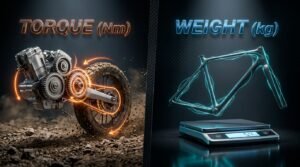
Weight vs Torque: Which One Matters More?
This is where many buyers get confused.
Imagine two bikes.
Bike A
20 kg
50 Nm
400Wh battery
Bike B
25 kg
75 Nm
600Wh battery
Bike A is easier to lift and may feel more agile.
Bike B may be substantially better when the road becomes steep.
That doesn’t mean Bike B is automatically the better bike.
It means the rider needs to decide which characteristic matters most.
For predominantly flat commuting, weight may be more important.
For steep Australian terrain, motor torque and gearing become much more important.
The Motor Position Matters
There are two major categories worth understanding.
Hub Motor
The motor is located in the front or rear wheel hub.
Advantages:
- Simple design
- Often less expensive
- Smooth operation
- Good for commuting
Disadvantages:
- Less efficient for very steep climbs
- Can feel less natural
- Wheel removal can be more complicated
- Doesn’t benefit from bicycle gearing in the same way as a mid-drive
Mid-Drive Motor
The motor drives through the bicycle’s crank and gearing.
Advantages:
- Excellent climbing ability
- Better weight distribution
- Uses bicycle gears
- Natural riding feel
- Efficient on varied terrain
Disadvantages:
- Usually more expensive
- Greater drivetrain wear
- More complex
- Replacement components can cost more
For Australian hills, a quality mid-drive system is often the configuration worth prioritising.
Don’t Ignore Gearing
A powerful motor cannot completely overcome poor gearing.
When climbing a steep hill, you want the drivetrain to provide a low enough gear that the motor and rider can maintain an effective cadence.
Look for:
- Wide-range cassette
- Suitable chainring
- Reliable shifting
- Enough low gears
- Good chain retention for trail riding
The Cube Reaction Hybrid Performance 600, for example, uses a Shimano 9-speed drivetrain with an 11–46T cassette.
That gives the rider useful low gearing for steep climbs.
Tyres Make a Bigger Difference Than Most Buyers Expect
Motor power doesn’t help much if the rear tyre can’t transfer that power to the ground.
For Australian hills, particularly on gravel and dirt, look for tyres with:
- Appropriate width
- Good tread
- Suitable pressure
- Strong sidewalls
- Adequate puncture protection
A 2.4–2.6-inch trail tyre can provide substantially more confidence on loose terrain than a narrow urban tyre.
But wider tyres also add rolling resistance and weight.
Again, there is a trade-off.
What About Lightweight Electric Bikes for Heavier Riders?
This is an important consideration.
A bike’s published weight is only one part of the equation.
Always check:
Maximum permitted system weight = rider + bike + luggage + accessories
For example, the 2026 Kalkhoff Endeavour 3 Move has a listed maximum total weight of 150 kg, despite weighing approximately 29 kg with its 600Wh battery.
A lightweight bike with a low maximum system weight may be a poor choice for a heavier rider carrying a backpack, panniers or other equipment.
Don’t choose purely by kilograms.
How We Assess Lightweight Electric Bikes for Hills
For this 2026 guide, the most important factors are:
1. Motor torque
Higher torque can provide stronger climbing assistance, provided the complete drive system is designed appropriately.
2. Motor type
Mid-drive systems generally have a major advantage for sustained climbing because they work through the bicycle’s gears.
3. Weight
Lower weight improves handling, transport and acceleration.
4. Battery capacity
A larger battery gives more energy reserve but adds weight.
5. Gearing
Low climbing gears are essential on steep gradients.
6. Tyres
Traction determines how effectively power reaches the ground.
7. Brakes
A good climbing bike also needs strong braking for the descent.
8. Suspension
For rough Australian trails, suspension can dramatically improve control.
Are Lightweight Electric Bikes Legal in Australia?
This needs to be understood before purchasing.
A bike being advertised as an “e-bike” does not automatically make it legal to ride everywhere in Australia.
For example, Victoria states that an EPAC e-bike must have a maximum continuous rated motor power of 250W, provide assistance while pedalling and cut motor assistance at 25 km/h.
Queensland’s current public-use requirements similarly specify 250W maximum continuous rated power, pedal assistance to 25 km/h and EN 15194 compliance, subject to its current assurance arrangements.
The Australian Government also notes that speed and power are key factors in determining whether an electric bike is treated as a bicycle or a road vehicle.
This is particularly important when comparing conventional e-bikes with high-powered machines such as:
- Sur-Ron
- Talaria
- E Ride Pro
- Electric dirt bikes
- Electric motorcycles
Those machines should not automatically be treated as ordinary road-legal e-bikes.
Lightweight Electric Bike vs Electric Dirt Bike
If you’re looking for hill-climbing performance, you may come across electric dirt bikes while researching e-bikes.
There is a major difference.
A conventional legal pedal-assist e-bike is designed around:
- Pedalling
- Bicycle geometry
- Bicycle components
- 25 km/h assisted speed
- Applicable bicycle regulations
An electric dirt bike is designed around:
- High power
- Motorcycle-style suspension
- Higher speeds
- Off-road performance
- Different legal classifications
A Sur-Ron or Talaria can climb dramatically more aggressively than a conventional e-bike, but that doesn’t make it a legal substitute for a commuter e-bike.
Choose according to where you are legally permitted to ride.
How to Get More Range on Australian Hills
If your battery range is important, small changes can make a noticeable difference.
Use the lowest assist that comfortably handles the climb
Maximum assistance uses more battery.
Shift into an easier gear
Don’t grind slowly in a high gear.
Let the motor and drivetrain work efficiently.
Maintain tyre pressure
Underinflated tyres increase rolling resistance.
Avoid unnecessary weight
Every kilogram matters on long climbs.
Keep the battery within the manufacturer’s recommended temperature range
Extreme heat can affect battery performance and longevity.
Maintain the drivetrain
A dirty or poorly lubricated drivetrain wastes energy and increases wear.
Our 2026 Lightweight Electric Bike Buying Guide
If you’re shopping for lightweight electric bikes Australia riders can use on hills, use this simple framework.
For commuting + hills
Look for:
50–75 Nm mid-drive motor + 400–600Wh battery + comfortable geometry
For trail riding + hills
Look for:
70–100 Nm mid-drive + 600–800Wh battery + hydraulic brakes + suspension
For technical mountain riding
Look for:
High-torque mid-drive + quality suspension + strong brakes + low weight + wide-range gearing
For maximum off-road performance
Consider an electric dirt bike or e-moto, but treat it as a different vehicle category and verify where it can legally be ridden.
The Bottom Line
The best lightweight electric bikes Australia riders can use on steep hills aren’t necessarily the bikes with the lowest number on the scales.
The real target is the right balance of:
Weight + torque + gearing + battery + tyres + brakes + suspension.
For many riders, a bike around 22–25 kg with a strong mid-drive system can offer an excellent compromise.
The 2026 Cube Reaction Hybrid Performance 600 is a particularly interesting example: approximately 24.8 kg, a 75 Nm Bosch Performance Line motor and a 600Wh battery, with current Australian retail pricing around $3,499 at the time of research.
For riders who want considerably more trail performance while keeping weight under control, carbon models such as the Cube AMS Hybrid ONE77 C:62 demonstrate how far premium eMTB technology has progressed, with a listed weight of approximately 21.4 kg and a Bosch CX-R system rated up to 100 Nm.
Ultimately, don’t buy an electric bike simply because the manufacturer advertises a large motor or impressive range figure.
For Australian hills, the complete system matters.
Choose the right motor, gearing, battery, tyres and chassis for the terrain you actually ride.
And before purchasing, always confirm that the exact e-bike configuration complies with the laws in the Australian state or territory where you intend to use it.
Looking for an electric bike that can handle Australian hills? Explore the ELECTRICK range or contact ELECTRICK PTY LTD for help choosing the right e-bike, eMTB or electric dirt bike for your riding.
Frequently Asked Questions
What is the best lightweight electric bike for hills in Australia?
There is no single model that suits every rider. A quality mid-drive e-bike with around 60–75 Nm of torque, suitable low gearing and a 500–600Wh battery is a strong configuration for steep Australian commuting and recreational riding.
How much torque does an electric bike need for hills?
Around 50 Nm can work for moderate hills, while 60–75 Nm provides a stronger setup for steeper terrain. High-performance trail e-bikes can provide 80–100 Nm or more.
Are lightweight electric bikes good for steep hills?
Yes. Weight is only one factor. A lightweight e-bike with a high-torque mid-drive motor and appropriate gearing can climb very effectively.
Is 250W enough for hills?
A compliant 250W EPAC can handle hills, but performance depends on the motor’s torque, gearing, rider weight, gradient and assist system. A 250W continuous rating does not tell the whole story.
Is a 20 kg electric bike better than a 25 kg electric bike?
Not necessarily. The lighter bike is easier to carry, but the heavier bike may have a larger battery, stronger motor, better suspension or more robust components.
Are Sur-Ron and Talaria electric bikes legal on Australian roads?
High-powered electric dirt bikes should not automatically be treated as legal pedal-assist bicycles. Their classification, registration and permitted riding areas depend on the exact model and jurisdiction. Check the current requirements before riding on public roads or paths.
Internal Links
Follow ELECTRICK