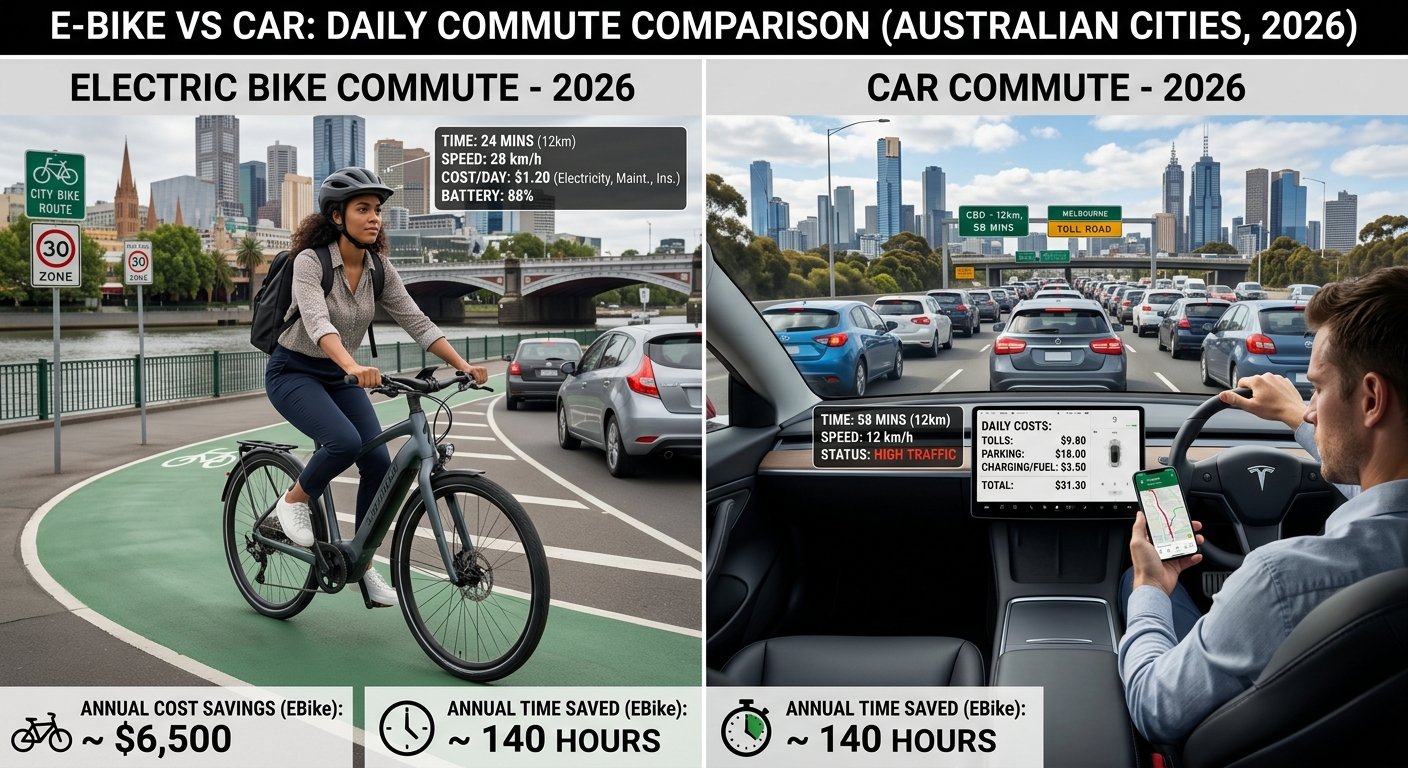

Electric Bike vs Car for Daily Commuting in Australian Cities: Real Cost & Time Comparison 2026
The electric bike vs car Australia debate comes down to more than fuel prices. For daily commuters in Sydney, Melbourne, Brisbane, Perth, Adelaide and other Australian cities, the real decision involves travel time, parking, running costs, distance, weather and convenience.
A car offers comfort, protection from the weather and flexibility for carrying passengers or heavy loads. An electric bike, however, can be cheaper to operate, easier to park and more predictable on congested urban routes.
So which option makes more sense in 2026?
This guide compares realistic commuting costs and journey times using a clear example. It also explains when an electric bike is a practical alternative, when a car remains the better choice, and how to calculate potential savings for your own commute.
Electric Bike vs Car Australia: The Key Differences
For shorter city journeys, a compliant electric bike can replace some car trips. It may be particularly useful when your workplace is within cycling distance and you have a safe route.
A car can be more practical when you travel long distances, work irregular hours, carry passengers or need to move equipment. The right choice depends on your circumstances.
Here are the main differences.
Electric bike advantages
- Low energy costs per kilometre
- Less dependence on petrol prices
- Easier parking in many urban areas
- Potentially more predictable travel during peak-hour congestion
- Physical activity built into your commute
- Lower routine running costs than many cars
Car advantages
- Better protection from rain, wind and extreme heat
- More suitable for carrying several passengers or bulky loads
- Greater flexibility for long-distance journeys
- Often more practical for dispersed workplaces and locations without safe cycling routes
- No need to arrive at work after riding in hot weather unless you choose to
The important distinction is that an electric bike does not replace every car journey. It can, however, be a useful replacement for suitable daily trips.
1. Real Commuting Costs: Electric Bike vs Car in 2026
To make the comparison fair, we need to use the same commute for both vehicles.
For this example, assume:
- One-way commute: 10 km
- Return distance: 20 km per working day
- Commuting days: 5 per week
- Working weeks: 46 per year
- Annual commuting distance: 4,600 km
These are illustrative assumptions, not a claim that every Australian commuter travels the same distance.
What does it cost to charge an electric bike?
Electric bikes use relatively little electricity compared with cars. The exact cost depends on battery capacity, energy consumption, electricity tariffs and charging losses.
For a simple estimate, assume the bike uses 10–15 Wh per kilometre from the battery.
At 4,600 km annually, that is approximately 46–69 kWh of battery energy. Allowing for charging losses, assume about 51–77 kWh drawn from the household supply.
At an illustrative electricity rate of $0.30 per kWh, annual charging would cost roughly $15–$23.
That is an energy estimate only. It does not include the bike’s purchase price, maintenance, tyres, insurance if applicable, accessories or eventual battery replacement.
What does fuel cost for a car?
For comparison, assume a petrol car consumes 8 litres per 100 km and petrol costs $2.00 per litre.
At 4,600 km per year:
- Fuel consumption: 368 litres
- Fuel cost: approximately $736 annually
Your actual fuel cost could be lower or higher depending on the car, traffic, driving style and local petrol prices.
The difference is already substantial: under these assumptions, the electric bike’s charging cost is only a small fraction of the car’s fuel bill.
However, fuel is not the same as the total cost of owning a car. Servicing, tyres, insurance, registration, depreciation, tolls and parking may add considerably more.
2. Annual Running Costs: Which Option Is Cheaper?
The most useful comparison separates everyday operating costs from the cost of owning the vehicle.
Electric bike costs
A typical annual budget may include:
- Electricity for charging
- Tyres, tubes and puncture repairs
- Brake pads and drivetrain maintenance
- Routine servicing
- Locks, lights and other accessories
- Insurance, if purchased
- A long-term allowance for battery replacement
The cost depends on the bike’s quality, distance travelled, riding conditions and how well it is maintained.
For a basic illustration, if charging costs $20 per year and you budget another $250–$500 for maintenance and consumables, annual running costs would be about $270–$520 before insurance, depreciation and battery replacement.
This is a planning example, not a universal Australian service-price estimate.
Car costs
A car’s annual costs may include:
- Petrol
- Servicing and repairs
- Tyres
- Registration and compulsory insurance charges
- Comprehensive insurance, if held
- Depreciation or finance costs
- Tolls and parking
Some costs are fixed or continue even if you drive less. Others depend on the kilometres travelled.
This distinction matters. If you already own a car and keep it regardless, replacing a commute with an electric bike may save fuel, parking and some wear-related costs—but it will not automatically eliminate your annual registration or insurance bill.
If you are deciding whether to buy a second car, the potential savings from avoiding a whole vehicle purchase may be much greater.
3. A Simple Cost Comparison for a 10 km Commute
Using the assumptions above, here is the basic energy and fuel comparison.
Electric bike
- Annual distance: 4,600 km
- Estimated charging cost: $15–$23
- Illustrative maintenance and consumables: $250–$500
- Estimated annual running subtotal: $265–$523
Petrol car
- Annual distance: 4,600 km
- Assumed fuel use: 8 L/100 km
- Assumed petrol price: $2.00/L
- Estimated annual fuel cost: $736
These figures are not a complete cost-of-ownership comparison. The car figure excludes servicing, tyres, insurance, registration, depreciation, tolls and parking. The e-bike figure excludes purchase cost, insurance if applicable, depreciation and battery replacement.
Even with those limitations, the example shows why electric bikes can be economical for regular short commutes.
4. Does an Electric Bike Save Time in Australian Cities?
Cost is only half the decision. Commuters also want to arrive on time.
An electric bike can sometimes compete with a car on a short urban journey, especially where traffic congestion and parking delays are significant. However, it is not always faster.
For a 10 km one-way commute, the following are illustrative door-to-door estimates, not measured averages for every Australian city.
Electric bike: approximately 25–40 minutes
This range allows for moderate riding speeds, traffic signals and some time to secure the bike. A direct route with good cycling infrastructure may be quicker, while steep hills, shared paths or busy intersections may slow the journey.
Car: approximately 20–45 minutes
A car may be faster on free-flowing roads. During peak hour, however, congestion, searching for parking and walking from the car park can extend the total journey.
What about public transport?
Public transport can outperform both options where a train or frequent bus serves the route directly. On the other hand, walking to the stop, waiting, transfers and service frequency can add time.
The best comparison is your actual door-to-door trip at the time you travel. Check the route during a normal weekday commute rather than relying only on map estimates.


5. The Hidden Costs That Change the Result
The biggest mistake when comparing an electric bike vs car in Australia is counting only petrol and electricity.
Parking
Parking can be one of the largest expenses for city workers. If you pay daily or monthly parking fees, replacing several car commutes with an e-bike may reduce that expense.
However, check whether your workplace offers free parking and whether secure bike storage is available. Not every commuter pays for parking, and not every destination provides safe bike storage.
Tolls
Some car commutes include toll roads. If you can use a practical cycling route instead, avoiding tolls may increase your savings. Do not assume that a bike route is a suitable substitute for a motorway journey, though; compare safe, permitted routes.
Maintenance
Electric bikes need maintenance, too. Tyres, brake pads, chains, drivetrains and batteries wear over time. A poorly maintained e-bike can become unreliable or expensive to repair.
Cars have their own servicing and repair costs, and their complexity can make some repairs expensive. Compare the maintenance needs of the specific vehicles rather than assuming either is maintenance-free.
Purchase price and depreciation
A car usually costs much more to buy than a conventional commuter e-bike, but purchase price alone does not tell the whole story. Cars may retain resale value, while e-bike resale value depends on the brand, condition, battery health and demand.
If you already own a car, buying an e-bike does not automatically save money overall. You need to calculate how much you will save by riding the bike and how long it will take to recover the purchase price.
6. How Much Could You Save by Replacing Car Trips?
Consider a commuter who pays for parking and regularly drives short distances in peak-hour traffic.
Replacing some of those trips with an electric bike could reduce fuel consumption, parking expenses and some wear-related vehicle costs.
The savings will vary substantially. Someone who pays $25 per day for parking has a very different opportunity from someone who parks free at work.
Use this basic calculation:
Potential annual savings = car costs avoided − electric bike costs added
Car costs avoided might include:
- Fuel for the replaced trips
- Paid parking
- Tolls
- Some mileage-related maintenance and tyre costs
Electric bike costs added might include:
- Purchase price, spread over the period you expect to use it
- Electricity
- Servicing and wear items
- Accessories, security and battery replacement allowance
Do not count the entire cost of car ownership as a saving if you will continue to own and maintain the car anyway.
Example: replacing paid parking
Suppose you currently pay $15 per workday for parking and replace your car commute on three days each week for 46 weeks.
That would avoid up to $2,070 a year in parking charges, assuming you no longer pay for parking on those days.
You could also save fuel and some wear-related costs. Against those savings, subtract the electric bike’s purchase and running costs.
This is an illustration, not a guaranteed saving. Your actual result depends on the fees you currently pay and how often you switch.
7. What About Safety, Weather and Convenience?
An electric bike is not the right choice for every commute.
Weather
Australian cities experience heat, rain and changing conditions. Riding can be uncomfortable during very hot weather, and wet roads can affect grip and braking. You may need suitable clothing, a change of clothes at work and a plan for bad-weather days.
Security
An e-bike can be an attractive theft target. Use a strong lock, secure it to an appropriate fixed object and consider safe indoor storage where available. Follow the manufacturer’s guidance for battery removal and storage.
Road conditions
Choose a route that you can ride safely and legally. A shorter route with fast traffic may be less suitable than a slightly longer route with cycling infrastructure.
Carrying passengers or equipment
A car remains more practical for many family trips, multiple passengers and bulky loads. A suitable cargo e-bike can carry some loads, but always follow the manufacturer’s limits and local rules.
Fitness and comfort
Electric assistance reduces the effort required, particularly on hills, but riding still involves physical activity. Test the bike for fit and comfort before committing to a daily commute.


8. Which Is Better for Sydney, Melbourne, Brisbane, Perth and Adelaide?
The best choice depends on your exact route, not just your city.
Sydney: Traffic, parking costs and hilly terrain can make an e-bike attractive for suitable short trips. Route quality and elevation are important, and longer cross-city journeys may still favour a car or public transport.
Melbourne: Some inner-city commutes are well suited to cycling, especially where you can use connected cycling routes. Weather, tram corridors, intersections and secure storage still need consideration.
Brisbane: Electric assistance can be useful on hills and in warm conditions. Plan around heat, humidity, safe routes and the distance you need to cover.
Perth: Some suburban commutes may be straightforward by e-bike, but distances can be long. Check whether your journey is realistic for the bike’s range and whether secure storage is available.
Adelaide: Shorter trips may be practical by e-bike, especially when parking is inconvenient. Compare the cycling route with driving and public transport for your actual travel time.
In every city, try your route before committing to an everyday e-bike commute. Consider a test ride, a trial journey on a day off or a mixed commute using public transport.
9. What Kind of Electric Bike Is Best for Commuting?
If you decide that an electric bike suits your journey, choose one designed for the type of riding you do.
Urban commuter e-bike
A commuter model is often the most practical option for daily transport. Look for comfortable geometry, reliable brakes, useful lights and the ability to fit a rack or mudguards.
Lightweight electric bike
A lighter model can be easier to carry upstairs or lift onto a rack. The trade-off may be a smaller battery or less equipment, depending on the design.
Folding electric bike
A folding model can be useful for limited storage space or some mixed-mode commutes. Check the folded dimensions, weight and the current rules of your public transport operator before planning to take it on board.
Electric mountain bike
An eMTB is suited to recreational trails and off-road cycling. It may be heavier, more expensive and less practical than a commuter model for everyday city transport.
High-powered electric dirt bikes
Machines such as Sur-Ron and Talaria-style e-motos are not simply substitutes for conventional commuter e-bikes. Their legal classification, performance and permitted riding locations can differ. Confirm the exact model’s status and local requirements before considering one for any public-road journey.
For everyday commuting, a conventional, compliant e-bike is generally the more straightforward starting point.
10. Final Verdict: Electric Bike vs Car in Australia in 2026
For short urban commutes, an electric bike can deliver substantial savings on energy and may reduce parking costs and time spent in traffic. It can also make daily travel more active and predictable when you have a safe, direct route.
A car remains useful for long distances, carrying passengers, transporting bulky items and journeys where cycling infrastructure is poor.
The strongest option for many people may be a combination: use an electric bike for suitable workdays and short errands, and keep the car for trips that genuinely require it.
Before making a decision, calculate your current costs, time your real route and include the full cost of owning the bike. That will give you a more reliable answer than a generic claim that one option is always cheaper or faster.
If you are exploring an e-bike for everyday Australian travel, browse the ELECTRICK shop or contact the team to discuss your intended use and the right type of bike.


FAQ section
Is an electric bike cheaper than a car in Australia?
An electric bike usually costs much less to charge than a petrol car costs to fuel for the same distance. Total savings depend on purchase price, maintenance, parking, insurance and whether you continue to own the car.
How much does it cost to charge an electric bike in Australia?
Charging costs depend on battery size, energy use and your electricity tariff. For the example in this guide, estimated annual charging costs are around $15–$23 for 4,600 km of commuting.
Is an electric bike faster than a car in Australian cities?
Sometimes, especially on short routes with congestion and difficult parking. Cars can be faster on clear roads or longer journeys. Compare actual door-to-door travel times for your route.
Can an electric bike replace a car for commuting?
It can replace many short commutes if you have a suitable route, secure storage and a bike that meets your needs. Cars remain more practical for many long-distance journeys, passengers and bulky loads.
How much could I save by commuting on an electric bike?
Your savings depend on how much driving you replace and the costs you avoid. Fuel, paid parking, tolls and some wear-related costs may fall, but fixed car expenses usually remain if you keep the vehicle.
Are electric dirt bikes suitable for everyday public-road commuting?
Do not assume so. High-powered electric dirt bikes and e-motos can have different legal classifications from conventional pedal-assist bicycles. Check the exact model and applicable state or territory requirements before use.