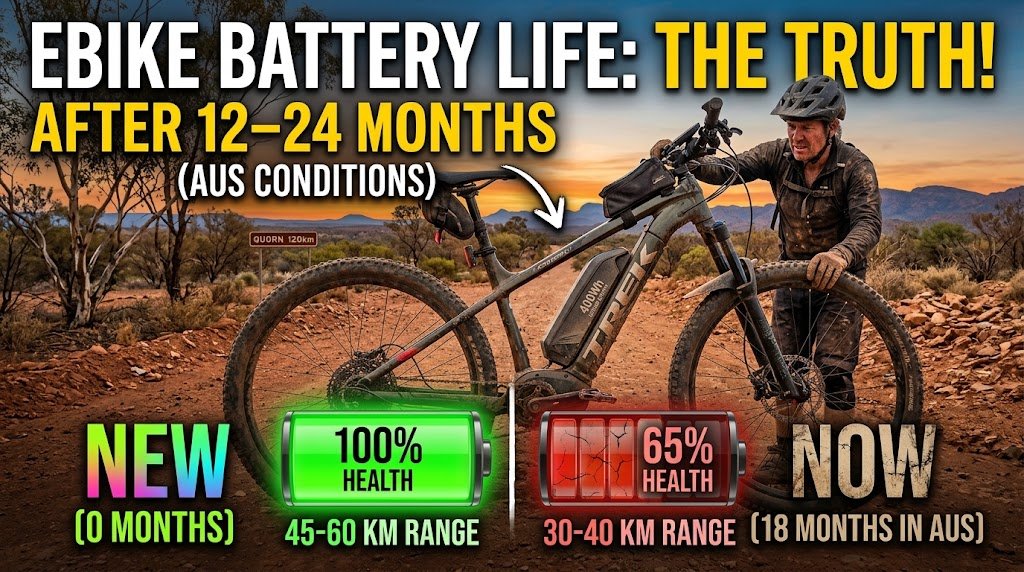

What Your Electric Bike Battery Life Really Looks Like After 12-24 Months in Australian Conditions.
If you are researching electric bike battery life, one of the biggest questions is what happens after the first year or two of ownership. Does the battery still deliver the same range? Will Australia’s heat wear it out faster? And when should you start thinking about a replacement?
The realistic answer is that battery performance depends on the battery’s quality, how often you ride, how hard you use the motor, where you store it and how you charge it. After 12–24 months, some riders may notice little change, while others may experience a more obvious reduction in range.
There is no universal percentage of battery capacity lost after two years. A commuter e-bike used gently and stored indoors can age very differently from a high-powered electric dirt bike regularly ridden hard on hot days.
This guide explains what Australian riders should look for, how to slow battery ageing and when a drop in performance could signal a problem. read more..
1. What Should Electric Bike Battery Life Look Like After 12–24 Months?
A lithium-ion battery gradually loses some of its ability to store energy as it ages. This is normal. The rate varies with battery design, cell quality, temperature, charging habits, usage and time.
After 12 months, a well-maintained battery may still feel close to new. After 24 months, some reduction in range may become noticeable, particularly if the bike is used frequently. However, age alone does not tell you whether a battery is healthy.
Rather than assuming a battery should lose a fixed percentage every year, monitor how it performs under comparable conditions.
Signs your battery is ageing normally
- You travel slightly less distance on a full charge than when the bike was new.
- Battery percentage falls gradually during a ride rather than suddenly.
- The battery charges and operates consistently.
- The battery casing remains intact, without swelling, cracks or other damage.
- The bike still provides predictable assistance under normal use.
A modest range reduction is not automatically a reason to replace a battery. However, a sudden change, inconsistent power delivery or physical damage needs investigation.
Why advertised range can be misleading
A battery may appear to have lost capacity when the real difference comes from riding conditions. Strong headwinds, steep climbs, low tyre pressure, heavier loads, cold weather, aggressive acceleration and higher assistance settings can all reduce range. read more..
For a meaningful comparison, use the same route, similar weather, similar load and the same assistance setting. Record the distance travelled and the remaining charge. Repeat the test before drawing conclusions.


2. How Australian Heat Affects Electric Bike Battery Life
Heat is one of the most important factors Australian owners should consider. Batteries can be exposed to high ambient temperatures, direct sunlight, hot garages and enclosed vehicles. Repeated heat exposure can accelerate battery ageing, particularly when a battery is also stored at a high state of charge.
That does not mean every ride on a hot Australian day will damage your battery. The bigger concern is prolonged exposure to excessive temperatures and poor storage practices.
Common Australian conditions that can shorten battery life
Leaving the bike in a hot car: An enclosed vehicle can become extremely hot, even when the outside temperature does not seem extreme. Do not leave an e-bike or battery in a parked vehicle.
Storing the bike in direct sunlight: A dark battery casing exposed to the sun can heat up significantly. Choose a cool, dry, shaded storage area.
Charging immediately after a demanding ride: If the battery is hot after a long climb or a hard off-road session, let it cool before charging, following the manufacturer’s instructions.
Keeping the battery fully charged in heat for extended periods: Avoid leaving a fully charged battery in a hot storage area for long periods. Follow the manufacturer’s guidance for long-term storage and recommended charge level.
Australia’s conditions differ by region. A bike stored in a cool, ventilated space in Tasmania may experience a different thermal environment from one kept in a hot shed in inland Queensland or Western Australia.
For official advice on safe battery storage and charging, see the ACCC’s lithium-ion battery guide.
3. Commuter E-Bikes vs Electric Dirt Bikes: Battery Wear Is Different
Not every electric bike battery has the same workload. The way you use your bike matters as much as how long you have owned it.
Daily commuter e-bikes
A commuter may use the battery for regular, relatively predictable journeys. Frequent charging is not automatically a problem; what matters is the battery’s overall use, temperature exposure and how it is charged and stored.
If you commute five days a week, track your typical range every few months. A gradual change is easier to identify when you have a baseline.
Electric mountain bikes
Electric mountain bikes often face repeated climbs, changing terrain and higher assistance demands. These conditions can use more energy per kilometre than steady riding on flat roads.
Keep tyres at the recommended pressure, select sensible assistance levels and avoid storing the battery somewhere hot between rides.
High-powered electric dirt bikes and e-motos
Machines such as Sur-Ron, Talaria, Segway and E Ride Pro models can place different demands on their battery systems, depending on the exact model and riding style. Hard acceleration, sustained high output, steep terrain and repeated off-road sessions can consume energy quickly and create additional heat.
Do not apply a conventional pedal-assist e-bike’s range expectations to a high-powered electric dirt bike. Their battery capacities, power demands and intended uses can be substantially different.
For all categories, use the battery and charger specified for the exact model. Never assume that a battery is compatible simply because it fits physically or has a similar connector.
Explore the ELECTRICK electric dirt bike range if you are comparing off-road electric models.


4. How to Tell If Your Battery Has Lost Range
A battery display showing 100% does not prove that the battery can still store the same amount of energy it could when new. Likewise, a lower range estimate does not automatically mean the battery is faulty.
Use a simple, repeatable check.
Step 1: Record a baseline
When the battery is in good condition, note the route, approximate distance, assistance setting, weather and remaining charge at the end. If you did not record this when the bike was new, start now.
Step 2: Repeat the same ride
Try to keep the route, load, tyre pressure and assistance setting similar. Avoid comparing a cool, calm ride with a hot, windy ride and assuming any difference is battery degradation.
Step 3: Look for a consistent pattern
If the bike repeatedly travels a shorter distance in similar conditions, the battery may have lost capacity. Other possible causes include tyre drag, brake rubbing, mechanical issues, changes in riding behaviour or a battery management fault.
Step 4: Get a professional assessment if needed
A qualified technician may be able to assess battery health, charging behaviour and fault codes, depending on the model. Battery capacity testing and repair options vary by manufacturer.
Do not open the battery pack or attempt a DIY cell replacement. Lithium-ion battery work can be dangerous and should be handled by suitably experienced professionals.
5. Seven Habits That Help Extend Electric Bike Battery Life
You cannot prevent normal ageing, but good habits can help reduce avoidable wear.
1. Keep the battery cool and dry
Store the battery away from direct sunlight, excessive heat and moisture. Avoid leaving it in a parked vehicle or an unventilated hot shed.
2. Let it cool before charging
After a demanding ride, allow the battery to return to an appropriate temperature before charging. Follow the model’s instructions, especially after high-output off-road use.
3. Use the correct charger
Use the charger supplied with the bike or one explicitly approved by the manufacturer. A plug that fits does not guarantee electrical compatibility.
4. Avoid unnecessary heat during charging
Charge in a suitable, ventilated location on a hard, non-flammable surface, away from exits and combustible materials. Do not charge while sleeping or leave the battery charging unattended. Disconnect it when fully charged, in line with official safety advice.
5. Follow the manufacturer’s storage guidance
If you will not ride for an extended period, check the manual for the recommended storage charge level and how often to check it. Do not leave the battery completely depleted for a long time unless the manufacturer specifically directs otherwise.
6. Use assistance settings sensibly
For pedal-assist bikes, lower assistance can reduce energy use when the terrain allows. For high-powered e-motos, avoid assuming that gentle riding and repeated full-power acceleration will deliver similar range.
7. Inspect the battery regularly
Look for dents, cracks, swelling, loose connections, corrosion or signs of water ingress. Do not continue using a battery that appears damaged or behaves abnormally.


6. When Should You Replace an Electric Bike Battery?
There is no single age at which every battery needs replacement. Some batteries may remain serviceable for years, while others may need attention earlier because of heavy use, poor storage, damage or a manufacturing fault.
Consider a replacement assessment if:
- The usable range has dropped significantly and consistently.
- The battery cuts out unexpectedly or power delivery becomes unreliable.
- The battery no longer charges normally.
- A technician confirms that capacity or performance has deteriorated beyond an acceptable level.
- The battery is damaged, swollen, leaking or overheating.
Safety comes first: if the battery is swollen, unusually hot, leaking, emitting vapour or smoke, or has suffered significant impact or water exposure, stop using and charging it. Do not try to test it with another charger or open the casing. Follow local emergency and disposal guidance.
A damaged battery is not simply an old battery. It may present a fire risk even if it still appears to work.
Before purchasing a replacement, confirm the exact model, voltage, battery specification, connector, battery management requirements and manufacturer compatibility. Buy from the original supplier or a reputable source. Avoid unverified second-hand batteries and improvised conversions.
The ACCC advises consumers not to use batteries showing signs of failure and not to dispose of lithium-ion batteries in household rubbish. Check local battery recycling options and follow the instructions for damaged batteries. See the ACCC safety guidance.
7. What About Battery Warranty After 12–24 Months?
Warranty coverage depends on the manufacturer, model, purchase terms and local consumer law. Battery warranties may have different conditions from those covering the frame, motor or other parts.
Before assuming a battery problem is covered—or that it is excluded—check:
- The warranty period for the battery specifically.
- Whether capacity loss is covered and how it is measured.
- Any cycle-count or usage conditions.
- Whether authorised servicing is required.
- The process for reporting a fault and obtaining an assessment.
Keep your purchase receipt, warranty information and any service records. If the range changes noticeably, record when it began and the conditions under which it occurs.
Do not assume that normal capacity degradation automatically qualifies for a free replacement. Equally, do not assume a product fault is excluded simply because the bike has been used for a year or two. Australian consumer guarantees may apply separately to the written warranty, depending on the circumstances.
8. Is an Electric Bike Battery Still Worth Keeping After Two Years?
Often, yes—provided it remains safe and performs adequately for your needs. A battery does not become useless just because it is 24 months old.
If your daily commute is short and the battery still comfortably covers it, a modest reduction in range may make little practical difference. If you regularly ride long distances or take demanding off-road trips, the same reduction may matter much more.
Think in terms of usable range rather than age alone. Ask whether the battery still meets your typical riding requirements, charges consistently and passes any needed professional checks.
For a new bike, consider battery replacement availability before buying. A reputable supplier, compatible replacement parts and clear support can make a real difference to long-term ownership costs.
You can browse the ELECTRICK shop or contact ELECTRICK with questions about a specific model or its battery support.
Frequently Asked Questions
How long should an electric bike battery last?
Battery lifespan varies with cell quality, usage, temperature, storage and charging habits. There is no guaranteed lifespan that applies to every e-bike or electric dirt bike. Follow the manufacturer’s guidance and monitor changes in real-world performance.
Is it normal for an e-bike battery to lose range after one year?
Some gradual reduction can be normal, but the amount varies. Compare rides under similar conditions before concluding that the battery has degraded. A sudden or severe change should be investigated.
Does Australian summer heat damage e-bike batteries?
Repeated exposure to excessive heat can accelerate battery ageing. Store batteries in a cool, dry place, keep them out of direct sunlight and never leave them in a hot parked vehicle.
Should I charge my e-bike battery to 100% every time?
Follow the manufacturer’s instructions. Some batteries and use cases have specific charging recommendations. For long-term storage, use the storage charge level specified in the manual rather than guessing.
Can I leave my e-bike battery charging overnight?
Avoid it. Australian safety guidance recommends monitoring charging, disconnecting the battery when full and not charging while asleep or away from home. Use the correct charger and charge in a suitable location.
How do I know if my e-bike battery is unsafe?
Warning signs include swelling, cracks, dents, leaks, unusual overheating, vapour or smoke. Stop using and charging a battery showing these signs, keep people away from danger and follow official emergency and disposal guidance.
Are Sur-Ron and Talaria batteries maintained the same way as commuter e-bike batteries?
The basic lithium-ion safety principles are similar, but the exact charging, storage and servicing requirements depend on the model. Follow the manufacturer’s instructions and use only compatible batteries and chargers.
Final Verdict: Battery Care Matters More Than the Calendar
After 12–24 months, electric bike battery life can range from almost unchanged to noticeably reduced. There is no honest one-size-fits-all percentage for Australian riders because heat exposure, usage, storage and battery quality vary so widely.
Keep your battery cool, charge it safely, use the correct charger and track range under comparable conditions. Treat physical damage and unusual heat as safety issues, not ordinary wear.
Whether you ride a commuter e-bike, an eMTB or a high-powered electric dirt bike, informed battery care can help you get more useful service from your investment—and help you recognise when a battery needs professional attention.